
Edited by:
redazione
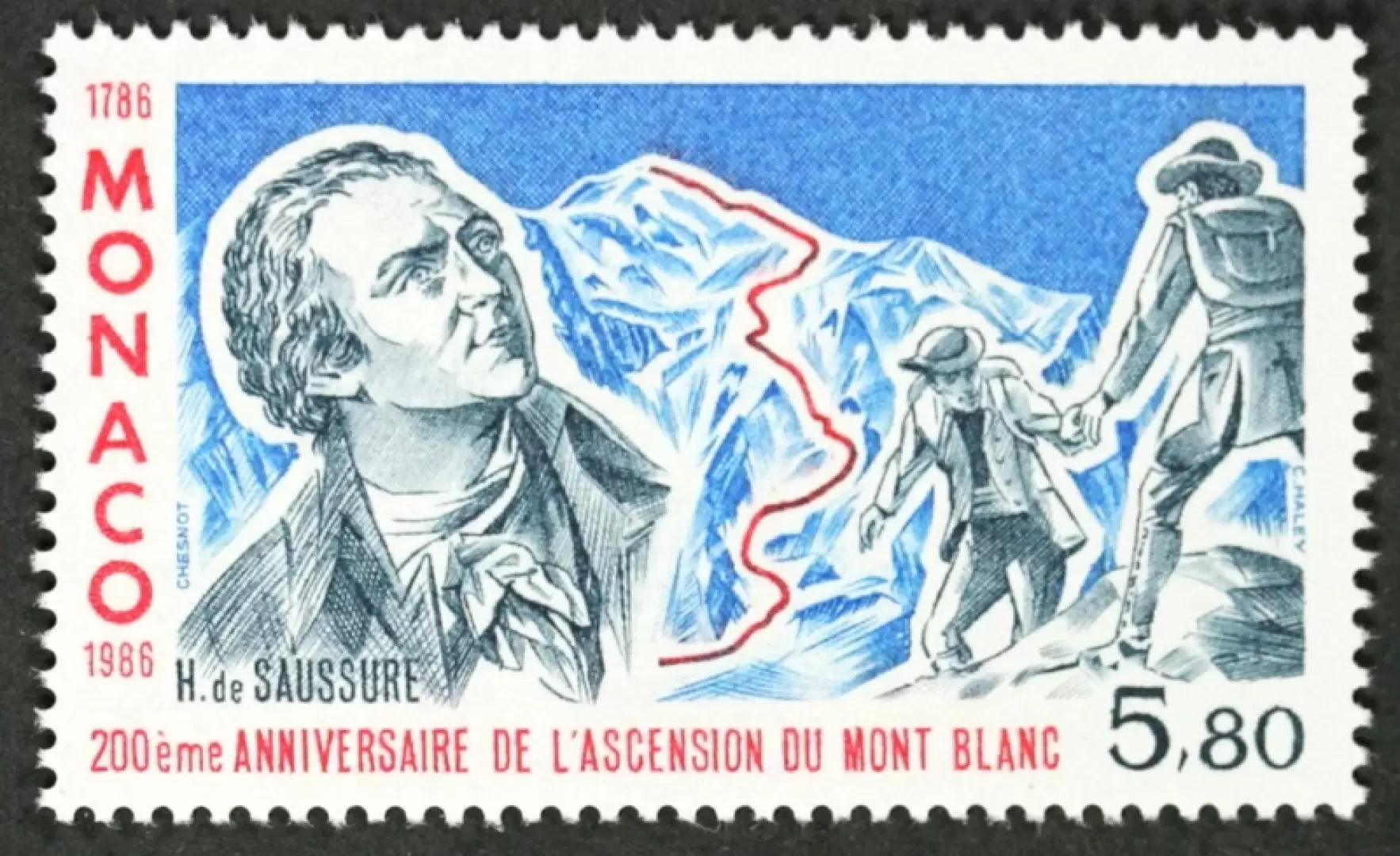
8 August 1786, at 6.23 p.m., the unconquered summit of Mont Blanc was conquered. A pole, wrapped in a red handkerchief, was driven into the soft snow at an altitude of 4,808 metres, where no human foot had ever left a footprint. History was being made – not the feat of mythological heroes, but the achievement of passionate mountaineers who, through sheer force of will, can achieve anything! It went down in history as the first great feat in the world of mountaineering!
Dr Michel Gabriel Paccard, together with Jacques Balamt, two citizens of Chamonix, had accomplished the feat of conquering the summit of Europe’s highest and most imposing mountain. Considered, until then, an absurd and reckless expedition – impossible for any human being – the two men, with stubborn determination and undisputed daring, proved all the scientific theories wrong that had deemed such an achievement unthinkable, succeeding where many had failed. Sinking into the snow, amidst the cold and untouched ice, lacking adequate equipment but driven by an age-old spirit of conquest, under the watchful eyes of their fellow townspeople and theclose observation of the German Baron von Gersdorff, who was tasked with documenting the feat, the two succeeded.
Admittedly, this was not an attempt by complete and reckless fools; they had traversed the snow-covered spurs of Mont Blanc many times before; Balmat (Chamonix 1762–1834), a man not particularly well-liked according to the accounts of his fellow townspeople, was a crystal hunter and a porter with an intimate knowledge of the mountains of his homeland; bold and physically powerful, he had led a simple life marked by poverty, hardship, serving first one master and then another, always in search of an elusive wealth that would never come. In the service of the powerful De Saussure (professor of philosophy and natural sciences at theUniversity of Geneva, he was an extraordinary mountaineer who conducted studies on the effects of altitude on the human body, as well as assigning various names to mountain peaks, such as the Dente del Gigante, formerly known as Gran Col. He climbed Mont Blanc, together with Balmat, on 5 July 1787), with whom he would be immortalised on the town monument in Chamonix; yet Balmat never had a good word to say about him, describing him as a difficult man to deal with. Among the many expeditions he undertook, one is still remembered in particular:feat in which he played a leading role: whilst left alone at night during a descent from a hike (9 June 1786), he dug a hole in the snow and, by crawling inside, managed to survive until the following morning. What was extraordinary was that no one had ever done anything like it, because curses were said to loom over the mountain’s slopes at night, and above all because Balmat’s equipment was certainly not up to the task. He succeeded. He climbed Mont Blanc no fewer than seven times between 1786 and 1818; then, in 1834, at thethe age of 72, he set out on a new expedition, determined to find gold on the mountain’s slopes (such was the rumour surrounding the mineral’s alleged presence); he never returned and his body was never found; Paccard (Chamonix 1757–1827), on the other hand, was a completely different sort of person: a doctor, a bourgeois scholar of science with a keen interest in botany, and a lover of the mountains who, in his own way, could be considered a scientist. He spent a great deal of time traversing the mountain paths, studying routes that might take him to the summit of Mont Blanc, whilst jealously guarding an ancient passion: to be the first man to climb and conquer this mountain. Raised in a well-to-do family, he cultivated a passion for learning from childhood until, in 1779, he qualified as a doctor; he undertook a standard professional internship in Paris (for two years, as required by the regulations of the Kingdom of Sardinia) before returning to Chamonix three years later, in 1782. Here he continued tirelessly to seek a way to conquer Mont Blanc, thereby satisfying his long-held desires. In 1783 – and this remains a memorable feat – he circumnavigated the entire mountain, reaching Courmayeur and then Aosta, where he was able to carry out botanical studies on certain species of local plants. Having accomplished this feat, his fame grew, leading him to hold political office in the region where he lived, in addition to the public office of Mayor, which he held until his death. He married Marie Angelique Balmat, with whom he had four children. Buried in Chamonix, his remains were lost in 1930 when the old cemetery underwent renovation.
The encounter
It was the morning of 10 June 1786, Balmat had miraculously survived a night at high altitude on the slopes of Mont Blanc, though he suffered signs of frostbite, which forced him to seek treatment from the village doctor. Paccard was waiting for him. Thus took place their first meeting, which would later develop into the fruitful collaboration that would enable them to conquer the majestic mountain.
"I, the undersigned, Jacques, son of J.P. Balmat, of the hamlet of Les Pèlerins, in the municipality of Chamonix, hereby declare to all whom it may concern: having learnt that Dr M. Paccard intended to make a further attempt on Mont Blanc, following his previous attempts, and knowing that his guide was absent, I offered my services to him. Since he had decided to follow the Côte route, a route which we had deemed impassable from Mont Blanc on 18 June last, I expressed doubts as to thesuccess of the expedition, but he reassured me, saying that he had already been exploring those areas through his telescope for two years.
I declare that without the steady pace he maintained, we would never have reached our destination; that he encouraged me constantly; that he shared the strain with me, sometimes taking part of the load that was mine; that, although I wished to turn back, as I had promised, to come to the aid of my wife and a son whom I had left behind, both of whom were ill (the latter died on 1 August), Mr Paccard dismissed my pleas as mere excuses.
He did not wish to follow the route taken on our last attempt, but proceeded directly across the plateau above the Bossons Glacier. He blazed the new route himself, leading the way ahead of me along a steep slope at the foot of the great Mont Blanc. As he had always told me that we would sleep on the mountain, as soon as we reached the top of the slope he ordered me to look for shelter, whilst he climbed up to examine some rocks. Having found no suitable spot, he decided to reach the summit – the goal of our expedition – that very afternoon. He called me and I followed him. At that moment I saw something black fly past me: it was his hat, blown away by the wind with such force that we never saw it again. Dr Paccard continued to climb nimbly; we reached a small rock behind which I took shelter from the wind whilst Mr Paccard examined it and loaded himself with stones. We were near the summit of the mountain; I veered to the left to avoid a steep snow slope, which Mr Paccard tackled decisively to reach the summit of Mont Blanc directly. The detour delayed me slightly, and I had to run to reach the summit almost at the same time as him. There he carried out experiments and made observations, which he noted down. He left a marker there, and we then descended rapidly, following our own track as we went along. We arrived at the Côte mountain, where Mr Paccard had also spent the night, on the side facing the glacier. He provided me with provisions, paid me, and returned to me some money that had been entrusted to him on my behalf.
In witness whereof, I have signed this document at Le Bourg de Chamonix today, 18 October 1786, in the presence of the undersigned witnesses.
Jacques Balmat
Counter-signed: Joseph Pot and Joseph Marie Crussa, the prescribed witnesses, who were expressly invited. (All on stamped paper, in accordance with local custom.)
Chamonix, 25 March 1787
These are the facts recounted in his own hand by Balmat; now follows the minute-by-minute account compiled by the journalist Théodore Bourrit:
Timeline
7 August 1786, Monday
3.00 pm Paccard leaves Chamonix (alt. 1,049 m) for the huts at Le Mont (alt. 1,175 m).
5.30 pm: Departure from Le Mont, ascent of the Montagne de la Côte.
9.00 pm: bivouac below the summit (alt. 2,329 m).
8 August, Tuesday
4.15 am: departure from the bivouac.
4.45 am: Arrival at the Gîte in Balmat (alt. 2,589 m, 30 minutes, a gruelling climb!).
5.00 am: Enter the Jonction Glacier.
10.00 am: on the Grands Mulets (alt. 3,051 m).
12.00 pm: on the Petites Montées (alt. 3,350 m).
1.52 pm: they are on the Grandes Montées (alt. 3,850 m).
3.00 pm: they are on the Grand Plateau (alt. 3,900 m; they’re starting to feel the strain!).
At 15:30, they set off along the Ancien Passage (alt. 4,121 m).
At 17:00, they reach the Rochers Rouges (alt. 4,450 m; an exceptional climb – the air is thin).
At 5.45 pm, they reach the Petits Rochers Rouges (alt. 4,577 m).
At 6.12 pm, they reach the summit of the Petits Mulets (alt. 4,690 m).
At 6.23 pm, they reach the summit! (alt. 4,807 m).
At 6.57 pm, they begin their descent.
00:00: Bivouac at Montagne de la Côte (alt. 2,329 m).
9 August, Wednesday
04:00: Return to Chamonix.
8.00 am: they arrive home safe and sound (alt. 1,049 m).
It was a remarkable feat that will forever leave us with a deep and sincere sense of admiration.